
How to Move About the World
Some content for the podcast listeners in the crowd

They say that finding your way as an artist or writer is often about finding your obsessions—letting your preoccupations take center stage, without worry that others won’t find the subject as fascinating as yourself. I find this easiest to observe in many painters. How many really felt a haystack worth hours of observation before Monet came along and painted them, again and again and again?
But I think it’s also the case that one’s unique obsessions aren’t always obvious. They feel natural, in the way a sports fan’s dedication feels natural to them, as they go about naively assuming that everyone else is also following the season and knows the latest score. Your own specialized focus can be something you take for granted, until mounting evidence lets you know you’ve possibly passed not just into superfan territory but maybe even beyond.
Mobility—how we move about the world—turns out to be one of my own obsessions, both political and artistic. There’s a fair amount of biographical accident in this, which may be why it took me some time to really accept it. And it may have also been due in part to context: I’ve lived a fair number of years in cities, in circles filled with urban planners and bike enthusiasts, where my own dedication to thinking critically about mobility felt normalized. Even then, these were obviously subcultures; but subcultures that could blend in more readily to the urban backdrop.
But also, how we move around is such a basic thing. It can be easy to believe that something so simple, so everyday, isn’t worth critical, careful attention. But that’s surely part of the point of art, or writing, or philosophy: to get us to pause and give an everyday object or practice more of our attention.
Now that I’ve attached myself to a more rural space, some of the flavors of my own obsessions take on a sharper contrast. The desire to talk about transit, here, generates more surprise, which may be part of why it has gained more notice. Or perhaps my own willingness to recognize it as a fixation unlikely to go away has made it easier to write the pieces I’ve been trying to write on the subject for sometime. I know I felt that way about last year’s “Uncanny Cars” essay.
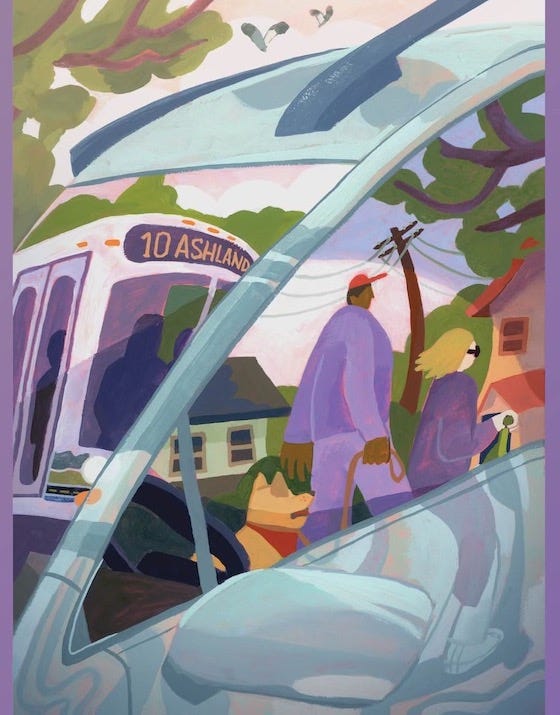
It turns out that one of the consequences of becoming marked as the person always writing or talking about a given topic is invitations for you to write more and talk more about it. And so it is that I’ve ended up on the radio somewhat regularly in the last month. Just this past week, I was on our local NPR affiliate along with a local transit manager and transit district board member, as part of a “Rural Voices Day,” to talk about “how rural transit connects communities in Southern Oregon.”
And last month, Oregon Humanities released an episode of their podcast The Detour, directly titled “How to Move About the World with Meg Wade.” We cover a lot of ground, touching on rural transit but dwelling more on questions of what it means to understand oneself as part of the public, and the way any form of transportation is likely to be a collective one, whether it’s acknowledged as such or not.
We didn’t really have a roadmap for the conversation—fitting for a show called The Detour, I suppose—which gave me room to share some fun stories, and to make all my favorite kinds of arguments: like seeing your daily commute as a potential adventure that can connect you more to the world, or the value of choosing, at least some of the time, to opt into more public and social modes of movement, rather than the more individual and personally tailored form of travel by car.
As I say on the show, such choices have bigger consequences than we might initially think, for “if we can't figure out how to be with other people in the everyday in these very basic ways, how are we gonna solve how to govern together?”
For Unsettling readers that are here specifically for thinking about our relationship to land, I hope you’ll continue to see some of the ways that the conversation about land and mobility are linked. What might it mean for us to think of the land as something we move with, rather than just through? What changes then?
I hope some of you will give it a listen. I’ve also shared links to some of our prior pieces on movement and mobility below.
Thanks for reading (and listening). Until next time,
Meg


